
Two-handled Cup and Saucer
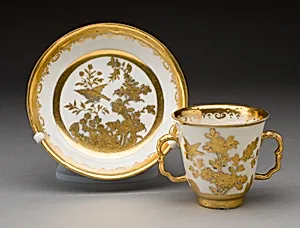
Medium
Hard-paste porcelain and gilding
Dimensions
Cup: 7.7 × 8.3 × 7 cm (3 × 3 1/4 × 2 3/4 in.); Saucer: 2.7 × 13.1 cm (1 1/16 × 5 1/8 in.)
Classification
drinking vessel
Department
Applied Arts of Europe
Museum
Art Institute of Chicago
Accession Number
68862
Rights
Public Domain
Art Historical Context
Step into the elegant world of 18th-century European with the *Two-handled Cup anducer* from the Meissen Porcelain Manuf, crafted around 1720–25. Produced in Dresden, Germany, Meissen was the first European workshop to master hard-paste porcelain—a breakthrough that rivaled the prized Chinese imports long coveted by royalty and nobility. This delicate drinking vessel, adorned with gilding for a touch of shimmering opulence, exemplifies the manufactory's pioneering techniques. Hard-paste porcelain, fired at high temperatures, achieved a translucent strength and fine white body impossible with earlier soft-paste imitations, revolutionizing applied arts. The two handles on the cup (measuring just 7.7 × 8.3 × 7 cm) suggest its use for fashionable hot beverages like chocolate, a novelty among Europe's elite. Paired with its shallow saucer (2.7 × 13.1 cm), it reflects the period's blend of functionality and extravagance. Housed in the Art Institute of Chicago's Department of Applied Arts of Europe, this piece highlights Meissen's role in elevating porcelain from exotic curiosity to a symbol of cultural sophistication, marking the dawn of Europe's own porcelain age.
About the Artist
Meissen Porcelain Manufactory
The Meissen Porcelain Manufactory, established on June 6, 1710, by Augustus II the Strong, Elector of Saxony and King of Poland, in the Albrechtsburg castle at Meissen near Dresden, marked Europe's breakthrough in producing true hard-paste porcelain. Building on experiments by physicist Ehrenfried Walther von Tschirnhaus and alchemist Johann Friedrich Böttger, who perfected the formula using local...