
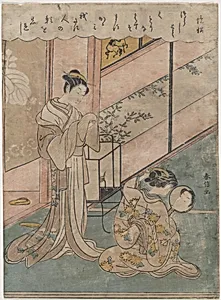
Two Ladies
1764–72
Medium
Woodblock print; ink and color on paper
Dimensions
H. 11 1/8 in. (28.3 cm); W. 8 1/8 in. (20.6 cm)
Classification
Prints
Culture & Period
Japan · Edo period (1615–1868)
Department
Asian Art
Museum
Metropolitan Museum of Art, New York, NY
Credit
H. O. Havemeyer Collection, Bequest of Mrs. H. O. Havemeyer, 1929
Accession Number
JP1640
Rights
Public Domain
Tags
Art Historical Context
Suzuki Harunobu's *Two Ladies* (1764–72) is a delicate woodblock print from Japan's Edo period (16151868), capturing the essence of ukiyo-e, or "pictures of the floating." Harunobu, a master of this genre, pioneered full-colorishiki-e prints around 1765, revolutionizing Japanese art by layering vibrant inks to achieve lifelike hues and subtle gradients. This intimate scene likely depicts two elegant women in a private moment, evoking themes of beauty and transience, with motifs like mirrors symbolizing self-reflection and poetry adding a layer of literary elegance—common in bijin-ga, or "pictures of beautiful women." Printed on paper with ink and color using intricate woodblocks carved by specialists, the work measures just 11⅛ × 8⅛ inches, perfect for personal albums or fans. Harunobu's soft lines and harmonious palettes distinguish his style, blending realism with poetic idealization to portray geisha or courtesans in everyday grace. Part of the H. O. Havemeyer Collection at the Metropolitan Museum of Art, it reflects the global fascination with Japanese prints in the 19th century. This print offers a window into Edo-era urban life in Tokyo (then Edo), where women navigated social worlds of art, poetry, and subtle allure, inviting viewers to ponder beauty's fleeting nature.
About the Artist
Suzuki Harunobu · 1725–1770
Suzuki Harunobu (c. 1725-1770) was a Japanese ukiyo-e artist who revolutionized woodblock printing by developing nishiki-e—full-color prints using multiple woodblocks—in 1765. Before Harunobu, Japanese prints were limited to two or three colors; his innovation unleashed the entire artist's palette, transforming ukiyo-e into the vibrant art form that would later captivate Western artists from Manet...