
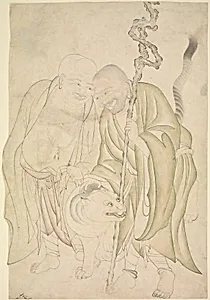
Two Lohans
Unknown Artist
ca. 1480
Medium
Ink and transparent watercolor on paper
Dimensions
Page: H. 13 9/16 in. (34.5 cm) W. 9 3/8 in. (23.8 cm) Mat: H. 24 in. (61 cm) W. 19 1/2 in. (49.5 cm)
Classification
Codices
Department
Islamic Art
Museum
Metropolitan Museum of Art, New York, NY
Credit
Rogers Fund, 1968
Accession Number
68.48
Rights
Public Domain
Tags
Art Historical Context
"Two Lohans" is a delicate folio from a codex, created by an unknown artist around 1480 using ink and transparent watercolor on paper. Measuring 13 9/16 by 9 3/8 inches on its page, this artwork hails from the Metropolitan Museum of Art's Islamic Art department, acquired through the Rogers Fund in 1968. Classified among codices—bound manuscript books—it exemplifies the refined tradition of Islamic manuscript illumination, where single pages often served as independent gems of storytelling and artistry. Lohans, or arhats, are revered Buddhist figures representing enlightened disciples of the Buddha, here depicted alongside animals and fellow men as suggested by the tags. Produced in the late 15th century, likely within Persianate or Timurid cultural spheres, the piece reflects fascinating cross-cultural exchanges along Silk Road trade routes, blending Eastern spiritual iconography with Islamic artistic conventions. The intimate scale invites close contemplation, revealing dynamic compositions of robed figures and creatures. Artistically, the medium shines through precise ink outlines paired with translucent watercolor washes, creating luminous depth and subtle color gradients typical of the era's miniaturists. This technique not only preserved vibrant details but also underscored the codex's role as a portable treasure for scholars and patrons, bridging religious worlds in a single, enchanting page.