
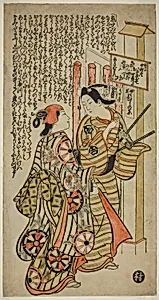
Two Lovers, Oshichi and Kichisaburo
c. 1708
Medium
Hand-colored woodblock print; o-oban, tan-e
Dimensions
56.4 × 29 cm (22 1/4 × 11 7/16 in.)
Classification
woodblock print
Department
Arts of Asia
Museum
Art Institute of Chicago
Accession Number
54774
Rights
Public Domain
Art Historical Context
In the vibrant world of early 18th-century Edo (modern Tokyo), Okumura Masanobu captures the poignant tale of *Two Lovers, Oshichi and Kichaburo* in this hand-colored woodblock print from 1708. Masanobu, a pioneeringkiyo-e artist, the ill-fated couple from a popular kabuki drama inspired by real events: young Oshichi, daughter of a greengro, falls deeply in love with temple servant Kichisaburo the 1682 Great Fire of Meireki. Separated by circumstance, her desperate act to reunite with him leads to tragedy, embodying the fleeting pleasures and sorrows of the "floating world." This o-oban tan-e print—measuring 56.4 × 29 cm—showcases Masanobu's innovative tan-e technique, or "red pictures," among the earliest hand-colored woodblocks. Bold black outlines frame vivid reds from vermilion pigments, hand-applied after printing, creating dramatic contrast and emotional intensity on a grand scale. As one of the first multi-color experiments in ukiyo-e, it bridges single-color benizuri-e and later full-color nishiki-e, revolutionizing Japanese printmaking. Housed in the Art Institute of Chicago's Arts of Asia department, this work invites visitors to ponder timeless themes of passion and sacrifice, reflecting Edo Japan's fascination with star-crossed lovers and theatrical culture.
About the Artist
Okumura Masanobu · 1686–1764
Japanese, 1686–1764