
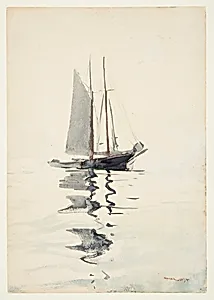
Two-masted Schooner with Dory
Classification
seascapes
Department
Smithsonian Collection
Museum
Smithsonian American Art Museum
Credit
Gift of Charles Savage Homer, Jr.
Accession Number
1912-12-189
Rights
Public Domain
About this artwork
Research in Progress
Art Historical Context
Winslow Homer, one of America’s most celebrated 19th-century artists, created *Two-masted Schooner with Dory* in 1894 during his mature period. By this time, Homer had settled in Prouts Neck, Maine, where the dramatic Atlantic coastline became his primary subject Known for shifting from Civil War illustrations and genre scenes to powerful marine subjects, he captured the sea’s moods with remarkable directness and realism. The painting depicts a two-masted schooner accompanied by a small dory, reflecting Homer’s deep interest in maritime life and the relationship between humans and the ocean. Such vessels were common along the New England coast in the late 1800s, and Homer often portrayed them to convey both the beauty and the peril of working waters. His seascapes from this era are admired for their strong compositions and sensitive handling of light and atmosphere. This work entered the Smithsonian American Art Museum through a generous gift from the artist’s brother, Charles Savage Homer, Jr., underscoring the personal significance these coastal scenes held for the family. Though its exact medium remains under study, the piece exemplifies Homer’s enduring contribution to American art’s celebration of the natural world.