
Two Mounted Arabs Killling a Lion
modeled late 1830s, cast probably before 1875
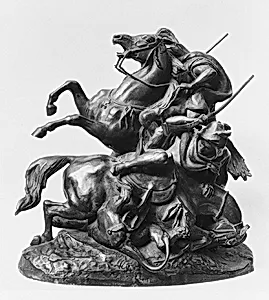
Medium
Bronze
Dimensions
H. 14 in. (35.6 cm.); L. 14-5/8 in. (37.1 cm.)
Classification
Sculpture-Bronze
Culture
French
Department
European Sculpture and Decorative Arts
Museum
Metropolitan Museum of Art, New York, NY
Credit
Gift of Mrs. Robert W. de Forest, 1926
Accession Number
26.278
Rights
Public Domain
Tags
Art Historical Context
Antoine-Louis Barye, a pioneering French sculptor of the Romantic era, crafted *Two Mounted Arabs Killing a Lion* in the late 1830s, with this bronze cast likely produced before 1875. This dynamic tabletop sculpture captures a thrilling moment of exotic hunting drama: two Arab riders on horseback thrust spears at a ferocious lion, their mounts rearing in the chaos. Standing just 14 inches tall and 14⅝ inches long, its compact scale belies the intense energy Barye infused through meticulous modeling of taut muscles, flowing manes, and rippling fur—hallmarks of his animalier style, which elevated wildlife to heroic subjects. Barye's work reflected 19th-century France's fascination with Orientalism, inspired by tales of North African adventures and the era's colonial imagination. As a master of bronze, he employed lost-wax casting to achieve lifelike textures and subtle patination, making the metal seem alive with movement and peril. This piece exemplifies his rejection of classical idealism for raw, naturalistic power, influencing generations of sculptors. A gift to the Metropolitan Museum of Art in 1926, it invites visitors to ponder the blend of human bravery, animal ferocity, and artistic bravura in a single, electrifying freeze-frame.
About the Artist
Antoine-Louis Barye · 1795–1875
Antoine-Louis Barye (1795–1875) was born in Paris on September 24, the son of goldsmith Pierre Barye and Marguerite Barye. Following family tradition, he apprenticed as a goldsmith under his father and, around 1810, with Martin-Guillaume Biennais, goldsmith to Napoleon. After brief military service, Barye pursued sculpture, studying under François-Joseph Bosio in 1816 and painter Baron Antoine-Jea...