
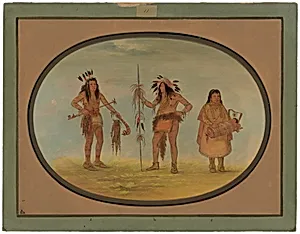
Two Ojibbeway Warriors and a Woman
1861/1869
Medium
oil on card mounted on paperboard
Dimensions
overall: 46.8 x 62.8 cm (18 7/16 x 24 3/4 in.)
Classification
Painting
Department
CAB
Museum
National Gallery of Art, Washington, D.C.
Credit
Paul Mellon Collection
Accession Number
1965.16.92
Rights
Public Domain
Art Historical Context
George Catlin's *Two Ojibbeway Warriors and a Woman* (1861/1869) captures the dignified presence of Ojibwe (Ojibbeway) individuals from one of North America's largest Indigenous nations. Painted in oil on card mounted on paper—a compact medium of 46.8 x 62.8 cm—this work reflects Catlin's lifelong dedication to portraying Native American life with authenticity. Though created later in his career, it draws from his pioneering travels in the 1830s among tribes west of the Mississippi, where he sketched and painted over 600 portraits to document cultures he feared were vanishing due to westward expansion. Catlin, a self-taught artist associated with American Romanticism and realism, rejected European artistic conventions to prioritize ethnographic accuracy. His vivid depictions, like this one showing warriors in traditional attire alongside a woman, served as both art and advocacy, forming the core of his famous "Indian Gallery" exhibitions. This painting's smaller scale and support suggest it may be a studio elaboration from field sketches, highlighting his methodical process. Housed in the National Gallery of Art's Paul Mellon Collection, the work underscores Catlin's cultural legacy: preserving Ojibwe identity amid 19th-century upheaval. Visitors are invited to appreciate its intimate power, a window into lives shaped by resilience and tradition.
About the Artist
George Catlin · 1796–1872
George Catlin (1796–1872), born in Wilkes-Barre, Pennsylvania, to Putnam Catlin and Polly Sutton—who had been captured by Native Americans during the 1778 Battle of Wyoming—initially pursued a legal career. Trained at Litchfield Law School, he was admitted to the bar in 1819 but abandoned law after two years to study art in Philadelphia in 1823. Self-taught as a portraitist, Catlin quickly gained ...