
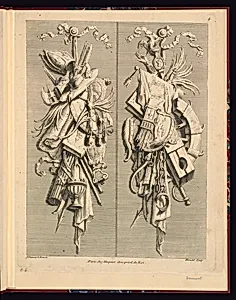
Two Ornamental Trophy Designs
Classification
Department
Smithsonian Collection
Museum
Smithsonian American Art Museum
Credit
Purchased for the Museum by the Advisory Council
Accession Number
1921-6-510-4
Rights
Public Domain
About this artwork
Research in Progress
Art Historical Context
Jacques Dumont (1701–1781), a prominent French sculptor and ornamental designer of the Rococo era, created *Two Ornamental Trophy* between 1729 and 1761. This print captures the exuberant spirit of 18th-century French decorative arts under Louis XV, when Rococo style flourished with its playful asymmetry, scrolling motifs, and lavish embellishments. Trophies—symbolic assemblages of attributes like garlands, masks, or instruments—were popular in architecture, furniture, and silverwork, serving as allegories of triumph, seasons, or virtues. As a print, the work likely served as a model sheet for artisans, disseminating Dumont's intricate designs across workshops in Paris and beyond. Rococo prints like this bridged fine art and craft, influencing European interiors and objets d'art. Though the exact medium remains unknown amid ongoing research, its classification highlights the era's innovative printmaking techniques, such as etching or engraving, prized for precision and reproducibility. Acquired for the Smithsonian American Art Museum through the Advisory Council, this piece underscores the museum's commitment to international decorative traditions. Visitors can appreciate how Dumont's elegant trophies evoke the opulent world of Versailles, blending artistry with everyday luxury.