
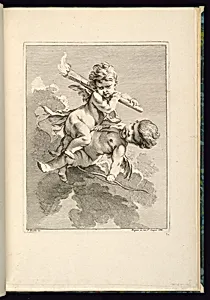
Two Putti
Medium
Classification
Department
Smithsonian Collection
Museum
Smithsonian American Art Museum
Credit
Purchased for the Museum by the Advisory Council
Accession Number
1921-6-247-20
Rights
Public Domain
About this artwork
Research in Progress
Art Historical Context
**Two Putti** by François Boucher, a French Rococo artist (1703–1770), captures the playful essence of 18th-century decorative art. Created between 1738 and 1749, this print features the artist's signature motif of *putti*—chubby, winged cherubs symbolizing love and innocence. Boucher, favored by Madame de Pompadour and King Louis XV, excelled in lighthearted, sensual scenes that adorned Versailles and fashionable salons, blending fantasy with exquisite elegance. As a print, the work highlights Boucher's mastery of reproductive techniques, likely etching or engraving, which allowed his designs to reach a broader audience beyond oil paintings or tapestries. Rococo prints like this one democratized elite tastes, influencing fashion, porcelain, and interior design across Europe. The undated range reflects the era's fluid production in Boucher's busy studio. Acquired for the Smithsonian American Art Museum through the Advisory Council's purchase, *Two Putti* joins the Smithsonian Collection of Prints, underscoring European artistic influences on American tastes. Though research continues, it invites visitors to appreciate Rococo's joyful whimsy in a compact, intimate format. (178 words)