
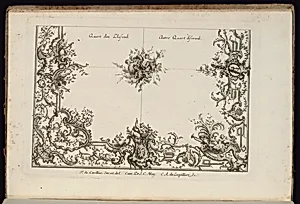
Two Quarters of a Ceiling
Medium
Bound print
Classification
Bound print
Department
Smithsonian Collection
Museum
Smithsonian American Art Museum
Credit
Purchased for the Museum by the Advisory Council
Accession Number
1921-6-281-79
Rights
Public Domain
About this artwork
Research in Progress
Art Historical Context
François de Cuvilliés the Elder (1695–1768), a Belgian-born architect and designer who made his mark at the Bavarian court in Germany, created *Two Quarters of a Ceiling* between 1740 and 1768. This bound print captures the opulent Rococo style that defined European decorative arts during the mid-18th century. Working primarily in Munich, Cuvilliés was a master of intricate interiors for palaces like the Amalienburg pavilion, blending French elegance with playful German flair. His designs often featured scrolling motifs, delicate shells, and asymmetrical flourishes, reflecting the era's shift from Baroque grandeur to lighter, more whimsical ornamentation. As a bound print, this work served as a practical pattern book plate, likely intended for cabinet makers, plasterers, or architects to replicate lavish ceiling decorations. Printed reproductions like this democratized high-style design, allowing skilled artisans across Europe to emulate royal splendor in homes and public spaces. The "two quarters" suggest detailed sections of a larger ceiling scheme, showcasing Cuvilliés' precision in rendering complex stucco or fresco elements. Housed in the Smithsonian American Art Museum's collection—purchased by the Advisory Council—this piece highlights the transatlantic exchange of architectural ideas. Though research continues, it invites us to appreciate how printed designs fueled the Rococo's spread, turning ceilings into canvases of fantasy and refinement.