
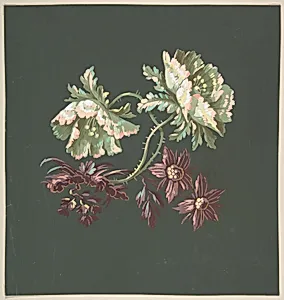
Two Roses and Two Small Flowers
19th century
Medium
Gouache on olive green prepared paper
Dimensions
sheet: 7 7/8 x 7 7/16 in. (20 x 18.9 cm)
Classification
Drawings
Department
Drawings and Prints
Museum
Metropolitan Museum of Art, New York, NY
Credit
Gift of H. A. Elsberg
Accession Number
28.55.3
Rights
Public Domain
Tags
Art Historical Context
Nestled among the delicate treasures of the Metropolitan Museum of Art's Drawings and Prints department,Two Roses and Two Small* is a charming 19th-century gouache on olive green prepared paper by an anonymous French artist. Measuring just 7 7/8 x 7 7/16 inches, this intimate sheet captures two blooming roses alongside modest smaller blooms, rendered with exquisite precision against the unconventional olive-toned ground. Gifted to the museum by H. A. Elsberg, it exemplifies the era's fascination with floral motifs. Gouache, an opaque watercolor prized for its velvety richness and matte finish, was a favored medium in 19th-century France for botanical studies and decorative sketches. The olive green preparation of the paper—likely sized and tinted for enhanced contrast—lends a subtle, naturalistic backdrop that makes the flowers pop vividly, evoking the lush gardens of the Romantic period. This technique highlights the artist's skill in layering luminous petals and fine details, blending scientific observation with artistic elegance. In a time when botany surged in popularity amid scientific exploration and horticultural enthusiasm, such works served both aesthetic delight and educational purposes, adorning private albums or inspiring textile designs. Roses, symbols of beauty and transience, invite viewers to pause and appreciate nature's quiet poetry in this understated gem.
About the Artist
Anonymous, French, 19th century · 1800–1900
**Anonymous, French, 19th Century (ca. 1800–1900)** The artist cataloged as Anonymous, French, 19th century embodies the enigmatic yet essential contributions of unidentified creators to France's vibrant 19th-century art world. Active roughly between 1800 and 1900, this figure—or potentially collective workshop—produced a diverse array of works amid the nation's transition from Neoclassicism thro...