
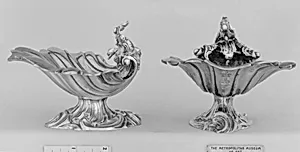
Two saltcellars
Unknown Artist
mid-18th century
Medium
Silver, gilt on upper surface
Dimensions
each: 3 1/2 × 4 in. (8.9 × 10.2 cm)
Classification
Metalwork-Silver
Culture
British
Department
European Sculpture and Decorative Arts
Museum
Metropolitan Museum of Art, New York, NY
Credit
Rogers Fund, 1913
Accession Number
13.42.40a, b
Rights
Public Domain
Art Historical Context
These elegant *Two Saltcellars*, crafted by an unknown British artist in the-18th century, the exquisite metalwork of the Georgian era. Standing at just 3½ × 4 inches each, these diminutive treasures were designed for the dining table, where salt—a precious commodity symbolizing wealth and hospitality—was ceremoniously presented. Made of silver with gilding on the upper, they shimmer with opulence, the gold enhancing durability against corrosive salt while adding a luxurious glow that caught the candlelight in grand households. In the context of British decorative arts, such silver pieces were hallmarks of refined taste and craftsmanship. Silversmiths employed skilled chasing, engraving, and gilding techniques to create functional yet sculptural objects, blending utility with artistry. Acquired through the Rogers Fund in 1913 for the Metropolitan Museum of Art's European Sculpture and Decorative Arts collection, these saltcellars offer a glimpse into 18th-century domestic luxury, where even tabletop essentials reflected social status and the era's burgeoning consumer culture. Today, they remind us of a time when every meal was a performance of elegance.