
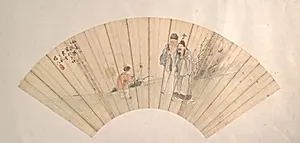
清 孫榮 觀鵝圖 扇頁|Two Scholars and Boy with Goose
19th century
Medium
Fan mounted as an album leaf; ink and color on silk
Dimensions
L. 19 3/4 in. (50.2 cm); open
Classification
Paintings
Culture & Period
China · Qing dynasty (1644–1911)
Department
Asian Art
Museum
Metropolitan Museum of Art, New York, NY
Credit
Gift of Mrs. Laurent Oppenheim, 1949
Accession Number
49.143
Rights
Public Domain
Tags
Art Historical Context
In the serene world of Qing dynasty (1644–1911) painting, Sun Rong's *Two Scholars and Boy with Goose* (觀鵝圖), created in the 19th, captures a moment of quiet contemplation. This delicate fan leaf, now mounted as an album leaf depicts two robed scholars and a young boy attending to a graceful goose, evoking the literati tradition of harmonizing with nature. Geese in Chinese art often symbolize loyalty and the fleeting beauty of autumn, inviting viewers to reflect on scholarly virtues amid everyday wonders. Rendered in ink and color on silk—a luxurious medium prized for its luminous sheen and absorbency—the artwork showcases meticulous brushwork typical of Qing professional painters. Originally a folding fan, its intimate 19¾-inch length (when open) made it a portable treasure, likely carried by elites for personal enjoyment or as a gift. Fans like this bridged utility and artistry, preserving scenes in compact elegance. Housed in the Metropolitan Museum of Art's Asian Art collection (gift of Mrs. Laurent Oppenheim, 1949), Sun Rong's piece exemplifies the dynasty's refined aesthetic, blending realism with poetic restraint. It's a window into imperial China's cultured leisure, where even a humble goose sparks philosophical delight.