
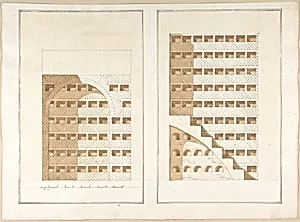
Two Sections of a Columbarium
Medium
Pen and brown ink, brush and brown wash, over ruling in graphite
Dimensions
12-11/16 x 17-3/8 in. (32.3 x 44.2 cm)
Classification
Drawings
Department
Drawings and Prints
Museum
Metropolitan Museum of Art, New York, NY
Credit
The Elisha Whittelsey Collection, The Elisha Whittelsey Fund, 1960
Accession Number
60.632.56
Rights
Public Domain
Tags
Art Historical Context
In the early 18th century, architect and draftsman Pietro Paolo Cocc (also known as Coc) captured intricate designs for funerary architecture in *Two Sections of a Columb* (1710–27). This detailed drawing presents cross-sectional views of a columbarium—a classical structure with niches for cremation urns, evoking ancient Roman tombs while adapting to Baroque-era grandeur. Housed in the Metropolitan Museum of Art's Drawings and Prints department, it how architects visualized multi-level spaces for the deceased, blending utility with ornate symmetry. Coccetti employed a meticulous technique typical of period architectural drawings: faint graphite rulings guide precise pen-and-brown-ink lines, enhanced by brush-applied brown wash to model light, shadow, and depth. This method brought flat plans to life, allowing patrons to "walk through" the design mentally. Measuring 12-11/16 x 17-3/8 inches, the sheet's scale highlights the columbarium's vaulted ceilings and tiered niches, showcasing Baroque engineering for solemn, monumental spaces. As part of The Elisha Whittelsey Collection, this work offers a window into 18th-century Italy's revival of antiquity in death rituals, reminding us how drawings like this bridged imagination and construction in an age of opulent memorials.
About the Artist
Pietro Paolo Coccetti (Cocchetti) · 1710–1727
Pietro Paolo Coccetti, also recorded as Cocchetti, was an Italian artist whose career was brief by any measure — the dates associated with him span only the years 1710 to 1727, suggesting either a very short life or a period of documented activity that represents only a fraction of his actual career. He worked within the Italian tradition of the eighteenth century, a period of great vitality in th...