
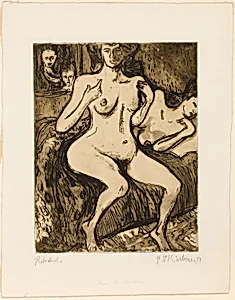
Two Sisters
Medium
Etching, from a zinc plate, in olive-green on white wove paper
Dimensions
Plate: 39.6 × 30.8 cm (15 5/8 × 12 3/16 in.); Sheet: 54.5 × 43 cm (21 1/2 × 16 15/16 in.)
Classification
etching
Department
Prints and Drawings
Museum
Art Institute of Chicago
Accession Number
60444
Rights
Public Domain
Art Historical Context
Ernst Ludwig Kirchner's *Two Sisters* (1908) captures the raw emotional intensity of early German Expressionism. As a founding member of Die Brücke (The Bridge), a radical Dresden-based group formed in 1905, Kirchner rejected academic traditions in favor of distorted forms, vivid colors, and psychological depth to convey modern life's alienation. Created during his formative Dresden years, this etching likely depicts two female figures in intimate, introspective poses, reflecting the group's fascination with urban vitality and human connection amid industrial change. Printed from a zinc plate in moody olive-green ink on white wove paper, the work showcases Kirchner's mastery of etching—a dry, incisive technique that allowed for sharp lines and textured effects unachievable in painting. Zinc plates, less common than copper, enabled bolder, more experimental mark-making, aligning with Die Brücke's innovative printmaking ethos. The plate measures 39.6 × 30.8 cm, with the full sheet at 54.5 × 43 cm, emphasizing its intimate scale suited for personal contemplation. Housed in the Art Institute of Chicago's Prints and Drawings department, *Two Sisters* exemplifies how Kirchner democratized art through affordable prints, bridging elite galleries and everyday viewers. Its subtle tonality invites us to ponder the sisters' unspoken bond, a timeless theme rendered with revolutionary vigor.
About the Artist
Ernst Ludwig Kirchner · 1880–1938
Ernst Ludwig Kirchner was born on May 6, 1880, in Aschaffenburg, Germany, to parents Ernst and Maria Kirchner, part of a family of Prussian descent that frequently relocated due to his father's career as a chemical technician. After early schooling in various towns, he studied architecture at the Königliche Technische Hochschule (Technical University) in Dresden from 1901 to 1905, taking courses i...