
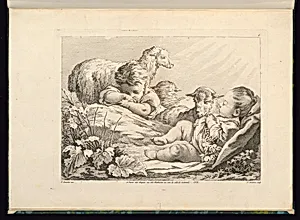
Two Sleeping Children with Sheep
Medium
Classification
Department
Smithsonian Collection
Museum
Smithsonian American Art Museum
Credit
Purchased for the Museum by the Advisory Council
Accession Number
1921-6-247-6
Rights
Public Domain
About this artwork
Research in Progress
Art Historical Context
In the opulent world of 18th-century France, Boucher (1703–1770) reigned as a master of Rococo, a style celebrated for its playful elegance, soft curves, and idyllic scenes of love, nature, and innocence. Created between 1758 and 1763, *Two Sleeping Children with Sheep exemplifies Boucher's fascination with pastoral harmony. As the favored artist of King Louis XV and his mistress Madame de Pompadour Boucher infused his works with a whimsical lightness, often drawing from mythology and rural reverie to evoke a dreamlike escape from courtly rigidity. This print captures two children in serene slumber amid gentle sheep, a tender motif symbolizing purity and the uncomplicated joys of childhood. Rococo prints like this one were vital for disseminating Boucher's lavish oil paintings to a wider audience, making high art accessible through affordable reproductions via etching or engraving techniques. The delicate lines and fluid forms highlight the medium's ability to convey softness and intimacy, turning a simple pastoral vignette into a celebration of fleeting beauty. Housed in the Smithsonian American Art Museum's collection—purchased by the Advisory Council—this piece bridges European refinement with American appreciation for such evocative imagery. Though research continues, it reminds us of Rococo's enduring charm: a brief, sugary interlude in art history's grand feast.