
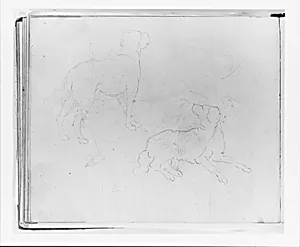
Two Studies of a Dog: Three Quarter Rear View Standing; Lying Down (from Sketchbook)
ca. 1838 and after
Medium
Graphite on off-white wove paper
Dimensions
6 5/8 x 8 in. (16.8 x 20.3 cm)
Classification
Drawing
Culture
American
Department
The American Wing
Museum
Metropolitan Museum of Art, New York, NY
Credit
Sheila and Richard J. Schwartz Fund, 1987
Accession Number
1987.196.3pp verso
Rights
Public Domain
Tags
Art Historical Context
In the tranquil pages of Francis William Edmonds' sketch from around 1838 later, visitors encounter *Two Studies of a Dog: Three Quarter Rear View Standing Lying Down*. This delicate graphite drawing on off-white wove paper6 5/8 x 8.) captures the artist's keen eye for animal anatomy, rendering a canine in poised standing and relaxed reclining poses. Edmonds, a prominent 19th-century American artist banker, and engraver in New York, often explored everyday subjects with meticulous detail, reflecting the era growing interest in naturalistic observation. These studies exemplify preparatory sketches typical of the Hudson River School-influenced American art scene, where artists honed compositions before committing to oils or engravings. Graphite's fine lines on smooth wove paper allowed for precise shading and texture, highlighting fur and form with subtle gradations. Housed in The Metropolitan Museum of Art's American Wing, the work—acquired through the Sheila and Richard J. Schwartz Fund in 1987—underscores dogs' enduring cultural role as symbols of loyalty and companionship in American genre art. A charming glimpse into an artist's process, these drawings invite us to appreciate the quiet artistry behind grander canvases, reminding us how humble sketches fueled the vibrant visual language of antebellum America.
About the Artist
Francis William Edmonds · 1806–1863
Francis William Edmonds, born on November 22, 1806, in Hudson, New York, into a prominent Quaker family as the seventh child of storekeeper and public servant Samuel Edmonds and Lydia Worth Edmonds, displayed remarkable artistic talent from youth. After Quaker schooling and farm work, he entered banking in 1823 as a clerk at the Tradesmen's Bank in New York City under his uncle Gorham Worth, a pat...