
Two Studies of an Elderly Man's Head
1601 to 1650
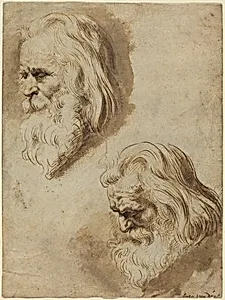
Medium
pen and brown ink with brown wash on laid paper, verso blackened for transfer
Dimensions
overall: 19.3 x 14.5 cm (7 5/8 x 5 11/16 in.)
Classification
Drawing
Department
CG-E
Museum
National Gallery of Art, Washington, D.C.
Credit
Julius S. Held Collection
Accession Number
1985.1.46
Rights
Public Domain
Art Historical Context
Behold the intricate "Two Studies of an Elderly Man's Head," a masterful drawing by Paulus Pontius after Sir Peter Paul Rubens, created sometime between 1601 and 1650. Rubens, the eminent Flemish Baroque artist renowned for his dynamic compositions and vivid realism, captured the profound character of his subject—an elderly man whose weathered features convey wisdom, resilience, and humanity. Pontius, a skilled engraver and Rubens' pupil, faithfully reproduced these studies, exemplifying the collaborative spirit of 17th-century Antwerp workshops. Executed in pen and brown ink heightened with brown wash on laid paper, the work measures a modest 19.3 x 14.5 cm, perfect for detailed preparatory sketches. The verso, blackened for transfer, reveals its practical purpose: facilitating the image's reproduction onto another surface, likely for engraving—a technique that allowed Rubens' genius to reach wider audiences through prints. Housed in the National Gallery of Art's Julius S. Held Collection, this drawing highlights Rubens' emphasis on life studies as the foundation of his grand history paintings and Pontius' role in disseminating Baroque artistry. It invites us to appreciate the tender observation of age and the enduring legacy of Flemish draftsmanship.