
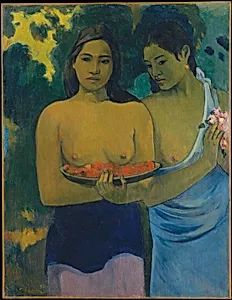
Two Tahitian Women
1899
Medium
Oil on canvas
Dimensions
37 x 28 1/2 in. (94 x 72.4 cm)
Classification
Paintings
Department
European Paintings
Museum
Metropolitan Museum of Art, New York, NY
Credit
Gift of William Church Osborn, 1949
Accession Number
49.58.1
Rights
Public Domain
Tags
Art Historical Context
Paul Gauguin's *Two Tahitian Women*1899), an oil on canvas measuring 37 x 28½ inches, captures the artist's fascination with Polynesian life during his second stay in Tahiti from 1895 to 1901. Fleeing the industrialization of Europe, Gaug sought an idyllic, "primitive" paradise, portraying Tahitian women as symbols of natural beauty and sensuality. This painting, now in the Metropolitan Museum of Art's European collection (gift of William Church Osborn,1949), exemplifies his Post-Impressionist vision, blending reality with exotic fantasy. Gauguin's technique features bold, flat areas of vibrant color outlined in black—his signature Synthetism—inspired by Japanese prints and stained glass. The nude figures, one holding a mango and the other perhaps a flower, evoke fertility and harmony with nature, though critics note his romanticized, Eurocentric view of Tahiti. Rather than literal portraits, they represent an escape from modern alienation. As a female nude, the work reflects Gauguin's recurring motif of idealized women, influencing later modernists like Picasso. Its cultural significance lies in pioneering Primitivism, challenging Western norms and inviting viewers to ponder colonialism's gaze on the "exotic Other." A mesmerizing window into Gauguin's dream world!
About the Artist
Paul Gauguin · 1848–1903
Paul Gauguin (1848-1903) was a French Post-Impressionist painter whose bold experiments with color, form, and subject matter made him one of the most influential figures in the transition from 19th-century art to modernism. His rejection of European civilization for the perceived authenticity of 'primitive' cultures established an archetype of artistic exile that continues to resonate. Gauguin's ...