
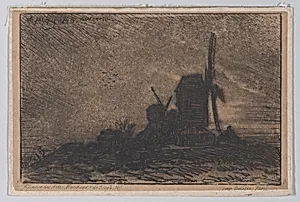
Two Windmills in Montmartre
Medium
Etching
Dimensions
Sheet (Trimmed): 2 3/4 × 4 1/16 in. (7 × 10.3 cm) Plate: 2 3/4 × 4 1/16 in. (7 × 10.3 cm)
Classification
Prints
Department
Drawings and Prints
Museum
Metropolitan Museum of Art, New York, NY
Credit
The Elisha Whittelsey Collection. The Elisha Whittelsey Fund, 1963
Accession Number
63.625.413
Rights
Public Domain
Tags
Art Historical Context
**Two Windmills in Montre** (1846) is a delicate etching by French artist Charles Jacque, with printing by master printer Auguste Delâtre. This intimate print, measuring just 2¾ × 4⅛ inches, captures a pair of windmills perched on the hilly Montmartre district of Paris. Jacque, a key figure in the emerging Realist movement and later the Barbizon School, renders the scene with fine lines that evoke the rural charm of Paris's outskirts during the July Monarchy era, before the area transformed into the bohemian heart of the city. Etching, the medium here, highlights Jacque's skill in intaglio printmaking: acid etched into a metal plate creates intricate textures, from the windmills' sails to the subtle landscape contours. Produced in 1846, the work reflects a fascination with everyday pastoral motifs amid France's industrializing landscape, where Montmartre's iconic windmills—symbols of leisure and grain milling—dotted the skyline. Delâtre's precise printing enhances the subtle tonal variations, making this a testament to collaborative artistry in 19th-century print workshops. Today, housed in the Metropolitan Museum of Art's Elisha Whittelsey Collection, this tiny gem offers a glimpse into pre-Impressionist Paris, bridging Romanticism and Realism while evoking the wind-swept allure that would inspire later artists like Van Gogh and Picasso in the same locale. (198 words)
About the Artist
Charles Jacque|Auguste Delâtre · 1813–1894
Charles-Émile Jacque (1813–1894) was a pioneering French painter, engraver, and illustrator whose career bridged the worlds of printmaking and pastoral painting. Born in Paris amid a difficult childhood, he apprenticed at age seventeen to a map engraver, mastering drypoint technique and producing his first etching in 1830—a copy of a head after Rembrandt. After serving seven years in the French Ar...