
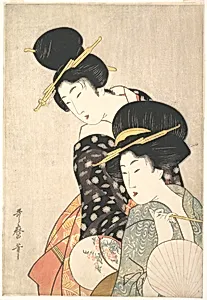
Two Women
ca. 1790
Medium
Woodblock print; ink and color on paper
Dimensions
15 3/8 x 10 1/8 in. (39.1 x 25.7 cm)
Classification
Prints
Culture & Period
Japan · Edo period (1615–1868)
Department
Asian Art
Museum
Metropolitan Museum of Art, New York, NY
Credit
The Howard Mansfield Collection, Purchase, Rogers Fund, 1936
Accession Number
JP2735
Rights
Public Domain
Tags
About this artwork
Kitagawa Utamaro's "Two Women" (circa 1790) exemplifies the artist's revolutionary approach to depicting female beauty during the golden age of ukiyo-e printmaking. Utamaro (circa 1754–1806) made his name in the 1790s with bijin ōkubi-e ("large-headed pictures of beautiful women") that emphasized faces and upper bodies, departing from earlier full-figure compositions. In this print, he arranges two beauties in a curved diagonal, one above the other, both gazing downward toward the left corner. T...
Art Historical Context
Kitagawa Utamaro's *Two Women* (ca. 1790) captures the essence of Edo-period Japan (1615–1868) during the golden age of ukiyo-e woodblock printing, a genre celebrating the "floating world" of pleasure districts and fleeting beauty. Utamaro (ca. 1754–1806) revolutionized depictions of women with his bijin ōkubi-e, or "large-headed pictures of beautiful women," focusing intimately on faces and upper bodies rather than full figures. This print, from The Metropolitan Museum of Art's Asian Art collection, exemplifies his mastery in a compact 15 3/8 x 10 1/8 in. format. In this innovative composition, two elegant women are arranged in a curved diagonal, one above the other, both gazing downward to the left, with the right edge daringly cropped to evoke a larger world beyond the frame. Utamaro contrasts their smooth, whitened faces—parted red lips against glossy black hair—with the intricate, vibrant patterns of their robes, highlighting 1790s fashion like reversible overall designs of water, bamboo, and white ikat on dark grounds. Refined color printing, achieved through artist, carver, and printer collaboration, brings these details to life. Beyond decoration, Utamaro infuses psychological depth, suggesting distinct personalities and moods. His works influenced European Japonisme, inspiring Impressionists and Post-Impressionists, making this Met impression a bridge between worlds.
About the Artist
Kitagawa Utamaro · 1753–1806
Kitagawa Utamaro (c. 1753-1806) was one of the most celebrated masters of ukiyo-e woodblock printing, revolutionizing the art of bijin-ga (pictures of beautiful women) during Japan's Edo period. Born Kitagawa Ichitaro, his early life remains shrouded in mystery, with conflicting accounts placing his birth in Kyoto, Osaka, Yoshiwara in Edo (modern Tokyo), or Kawagoe in Musashi Province. Under the t...