
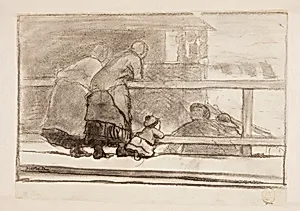
Two Women and a Child at a Rail, Overlooking Beach at Tynemouth
Classification
figures
Department
Smithsonian Collection
Museum
Smithsonian American Art Museum
Credit
Gift of Charles Savage Homer, Jr.
Accession Number
1912-12-17
Rights
Public Domain
About this artwork
Two women and a child lean over railing, looking out to sea, as men in raincoats and caps below the boardwalk also look out to sea. A Life Brigade house is directly in front of them, in the middleground; rough sea traversed by several shore bound ships, in the background.
Art Historical Context
In 1881, American artist Winslow Homer captured the dramatic tension between humanity and the sea in *Two Women and Child at a Rail,looking Beach at Tyn*. This evocative scene depicts two women and a child peering over a railing toward a turbulent ocean, while men in raincoats below the boardwalk gaze seaward. Dominating the middle ground is a Life Brigade house—a coastal rescue station—framed by shore-bound ships battling rough waves evoking the perilous life of North Sea fishermen. Homer a master of American Realism, created this during his transformative stay in Tynemouth, England (1881–1882), where the rugged coastline inspired his shift toward monumental marine paintings. Fresh from Civil War illustrations, he immersed himself in the local fishing community, highlighting themes of vigilance and nature's raw power. The composition draws viewers into shared anticipation, with figures united by the sea's mystery. Though the medium remains unspecified, Homer's precise realism and dynamic composition underscore his legacy at the Smithsonian American Art Museum, gifted by his family. This work exemplifies his fascination with everyday heroism amid elemental forces, inviting us to ponder the timeless pull of the horizon.