
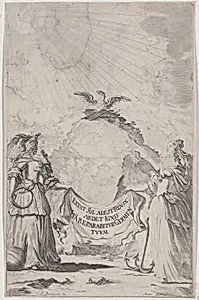
Two women holding a banner at center as a phoenix rises above; set design from 'Il Fuoco Eterno'
Medium
Etching
Dimensions
Sheet (Trimmed): 10 3/16 × 6 9/16 in. (25.9 × 16.7 cm)
Classification
Prints|Prints-Fete|Ornament & Architecture
Department
Drawings and Prints
Museum
Metropolitan Museum of Art, New York, NY
Credit
Harris Brisbane Dick Fund, 1953
Accession Number
53.600.3562
Rights
Public Domain
Tags
About this artwork
This etching work by Mathäus Küsel|Ludovico Ottaviano Burnacini, titled 'Two women holding a banner at center as a phoenix rises above; set design from 'Il Fuoco Eterno'' and created 1674, represents an important example of artistic production from this period. Mathäus Küsel|Ludovico Ottaviano Burnacini's practice contributed to the broader artistic traditions of the time, demonstrating the technical skills and aesthetic sensibilities characteristic of Drawings and Prints artworks in museum coll...
Art Historical Context
Step into the dramatic world of 17th-century Baroque theater with this enchanting 1674 etching, *Two Women Holding a Banner at Center a Phoenix Rises Above; Set Design from 'Iloco Eterno'*. by the collaborative talents of stage designer Ludovico Ottaviano Burnac and engraver Mathäussel, it captures a fantastical scene where two women grasp a central banner while a majestic phoenix soars overhead, symbolizing rebirth and eternal fire—themes resonant with the opera's title, *Il Fuoco Eterno*. At 10 3/16 × 6 9/16 inches, this trimmed sheet exemplifies the intricate ornament and architecture of festive prints (prints-fête), designed for Habsburg court spectacles in Vienna. Burnacini, a master of illusionistic stagecraft, and Küsel, renowned for his precise reproductive etchings, showcase Baroque exuberance through dynamic composition and fine line work. Etching's fluid technique allowed Küsel to translate Burnacini's elaborate designs into portable prints, disseminating grand theatrical visions to a wider audience. These works bridged architecture, ornament, and performance, reflecting the era's cultural splendor amid opera's rise. Housed in the Metropolitan Museum of Art's Drawings and Prints department (Harris Brisbane Dick Fund, 1953), this piece preserves a slice of historical pageantry. Imagine the flickering torchlight and soaring melodies it once evoked— a testament to art's power to immortalize spectacle. (198 words)
About the Artist
Mathäus Küsel|Ludovico Ottaviano Burnacini · 1629–1681
Matthäus Küsel (1629–1681) was a distinguished German copper engraver who achieved prominence as court engraver to the Holy Roman Emperor, earning the prestigious title of imperial court engraver (Hofkupferstecher). Born into the renowned Augsburg engraving and goldsmith family Küsel, Matthäus represented the height of German reproductive engraving in the Baroque period. His extensive oeuvre encom...