
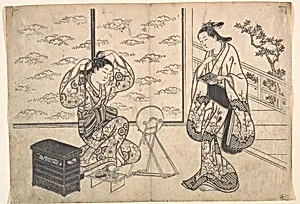
Two Women in a Room Opening on a Verandah
ca. 1730
Medium
Monochrome woodblock print; ink on paper
Dimensions
10 1/2 x 15 in. (26.7 x 38.1 cm)
Classification
Prints
Culture & Period
Japan · Edo period (1615–1868)
Department
Asian Art
Museum
Metropolitan Museum of Art, New York, NY
Credit
Harris Brisbane Dick Fund and Rogers Fund, 1949
Accession Number
JP3083
Rights
Public Domain
Tags
About this artwork
This prints by japanese artist Hasegawa Mitsunobu exemplifies the artistic achievements of ca. 1730. Japanese artists developed sophisticated visual traditions with distinct aesthetic principles that profoundly influenced both Eastern and Western art. The artist's work in monochrome woodblock print; ink on paper demonstrates the importance of printmaking as both an artistic medium and a means of disseminating images widely. Executed in monochrome woodblock print; ink on paper, this work demonstr...
Art Historical Context
**Two Women in a Room on a Verandah** by Hasegawa Mitsun, created around 1730 during Japan's Edo period (16151868), captures an intimate domestic scene through the delicate art of monochrome woodblock printing ink on paper. Measuring 10½ x 15 inches—a scale typical for such prints—this work reflects the refined craftsmanship of ukiyo-e traditions, where artists depicted everyday life, beauty, and fleeting moments with poetic subtlety. The title evokes a serene interior opening onto a verandah, likely featuring women and mirrors, symbols of vanity and reflection in Japanese culture. Hasegawa's mastery of woodblock techniques highlights printmaking's revolutionary role: carvers meticulously sculpted woodblocks, printers applied ink for precise impressions, and multiple editions made art accessible beyond elite patrons. This monochrome format emphasized line work and tonal subtlety, embodying Edo aesthetics of harmony, impermanence, and nature's integration into daily life—principles distinct from Western realism. Preserved at the Metropolitan Museum of Art through the Harris Brisbane Dick and Rogers Funds, this print not only showcases Mitsunobu's skill but also underscores Japanese art's global ripple, inspiring 19th- and 20th-century Western artists like Whistler and Van Gogh with its elegant simplicity and innovative dissemination. A window into Edo-era elegance! (198 words)