
Two Women (Zwei Frauen)
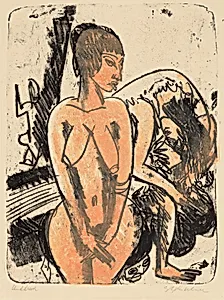
Medium
lithograph, printed in black and pale orange inks, on wove paper
Dimensions
image: 42 x 32 cm (16 9/16 x 12 5/8 in.) sheet: 53.8 x 41.9 cm (21 3/16 x 16 1/2 in.)
Classification
Department
CG-W
Museum
National Gallery of Art, Washington, D.C.
Credit
Gift of Ruth Cole Kainen
Accession Number
2012.92.143
Rights
Public Domain
Art Historical Context
Ernst Ludwig Kirchner's *Two Women (Zwei Frauen)*, in 1914, the raw emotional intensity of German Expressionism. As a founding member of the group Die Brücke, Kirchner rejected traditional realism in favor of distorted forms, vivid colors, and bold lines to convey inner turmoil and modern life's alienation. This lithograph, made on the eve of World War—a time when Kirchner grappled with anxiety and the looming conflict—exemplifies his focus on the female figure as a symbol of vitality and sensuality amid societal upheaval. Printed in black and pale orange inks on wove paper, the work showcases lithography's versatility for Expressionist artists. This planographic technique allowed Kirchner to achieve crisp, gestural lines and subtle tonal variations, making complex compositions reproducible and accessible. The modest image size (42 x 32 cm) invites intimate viewing, emphasizing the women's dynamic poses and expressive contours that pulse with psychological depth. Housed in the National Gallery of Art's print collection (gift of Ruth Cole Kainen), *Two Women* highlights Kirchner's innovative printmaking, bridging fine art and mass medium. For visitors, it offers a window into early 20th-century Germany's artistic rebellion, where personal expression trumped convention.
About the Artist
Ernst Ludwig Kirchner · 1880–1938
Ernst Ludwig Kirchner was born on May 6, 1880, in Aschaffenburg, Germany, to parents Ernst and Maria Kirchner, part of a family of Prussian descent that frequently relocated due to his father's career as a chemical technician. After early schooling in various towns, he studied architecture at the Königliche Technische Hochschule (Technical University) in Dresden from 1901 to 1905, taking courses i...