
Two Youths
1906
Medium
oil on canvas
Dimensions
overall: 151.5 x 93.7 cm (59 5/8 x 36 7/8 in.) framed: 182.3 x 121.9 x 6 cm (71 3/4 x 48 x 2 3/8 in.)
Classification
Painting
Department
CMC
Museum
National Gallery of Art, Washington, D.C.
Credit
Chester Dale Collection
Accession Number
1963.10.197
Rights
Public Domain
Art Historical Context
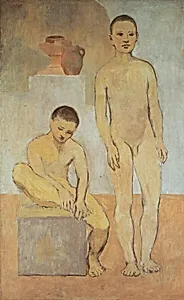
"Two Youths" (1906) is a striking oil on canvas by Pablo Picasso, measuring an impressive 151.5 93.7 cm. Created during the artist's transitional Rose Period—a shift from the somber blues of his earlier works to warmer pinks, ochres, and earth tones—this painting captures two young male figures in a poised, almost classical composition. Picasso, then in his mid-20s and living in Paris, was experimenting with form and emotion, drawing inspiration from the circus world and ancient Iberian art, laying groundwork for his revolutionary Cubism. The medium of oil on canvas allowed Picasso to layer vibrant hues and subtle textures, emphasizing the youths' slender forms and contemplative expressions. This work reflects the period's fascination with youth and vitality, contrasting the melancholy of his Blue Period. Its large scale invites viewers to immerse themselves in the figures' quiet intensity, a hallmark of Picasso's evolving style. Generously gifted through the Chester Dale Collection, "Two Youths" resides in the National Gallery of Art's painting department. It offers a window into Picasso's rapid artistic growth, bridging traditional portraiture and modernism for generations of visitors.
About the Artist
Pablo Picasso · 1881–1973
Pablo Picasso (1881–1973), born Pablo Diego José Francisco de Paula Juan Nepomuceno María de los Remedios Cipriano de la Santísima Trinidad Ruiz y Picasso in Málaga, Spain, was the son of José Ruiz Blasco, a painter and art professor who served as his first teacher. From age seven, Picasso trained under his father in figure drawing and oil painting, mastering naturalistic techniques by copying mas...