
Ugolino
19th century
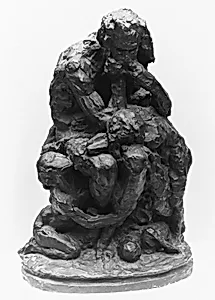
Medium
Plaster, painted black
Dimensions
Overall: 21 3/16 × 14 × 11 in. (53.8 × 35.6 × 27.9 cm)
Classification
Sculpture
Culture
French
Department
European Sculpture and Decorative Arts
Museum
Metropolitan Museum of Art, New York, NY
Credit
Anonymous Gift, 1945
Accession Number
45.69
Rights
Public Domain
Tags
Art Historical Context
Jean-Baptiste Carpeaux's *Ugolino* (19th century) is a poignant plaster sculpture, painted black for dramatic effect, capturing a harrowing moment from Dante Alighieri's *Infer*. The work depicts Ugolino della Gherardesca, a 13th-century Pisan noble condemned to starve in a tower with his sons, inspired by Canto XXXIII where desperation blurs the line between paternal love and primal survival. Carpeaux, a leading French sculptor of the Romantic Realist movement, masterfully conveys anguish through twisted forms and expressive faces, blending classical anatomy with emotional intensity. Measuring 21 3/16 × 14 × 11 inches, this piece exemplifies Carpeaux's skill in terracotta and plaster modeling, techniques honed during his Prix de Rome training in Rome. The black paint enhances its shadowy, infernal mood, evoking bronze memorials while highlighting the raw humanity of suffering. Tags noting "Children" and "Men" underscore the tragic father-son dynamic, a theme that resonated in 19th-century France amid social upheavals. Housed in the Metropolitan Museum of Art's European Sculpture and Decorative Arts department (Anonymous Gift, 1945), *Ugolino* showcases Carpeaux's ability to transform literary horror into visceral art, inviting visitors to ponder the depths of human endurance.
About the Artist
Jean-Baptiste Carpeaux · 1827–1875
Carpeaux's exuberant work was a decisive break from Neoclassical art. He won the Prix de Rome in 1854 and received many portrait bust commissions from the court. His most famous sculpture group is 'La Danse' (1869) made for the Paris Opéra. So bold is its message of bacchanalian revelry that it was vandalized in protest. French artist.