
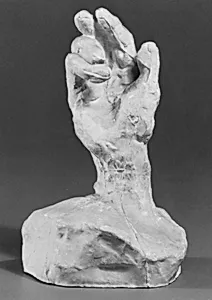
Hand with base
modeled possibly ca. 1885
Medium
Cast plaster
Dimensions
Height: 3 1/4 in. (8.3 cm)
Classification
Sculpture
Culture
French
Department
European Sculpture and Decorative Arts
Museum
Metropolitan Museum of Art, New York, NY
Credit
Presented by Rodin to his pupil Malvina Hoffman and given by her to The Metropolitan Museum of Art, Bequest of Malvina C. Hoffman, 1966
Accession Number
66.247.2
Rights
Public Domain
Tags
Art Historical Context
This intimate plaster sculpture, titled * with base*, was modeled by the French artist Auguste Rodin possibly around 1885. Measuring just 3 1/4 inches high, the small-scale work captures a human hand in careful detail, resting on a simple base. As a cast plaster piece, it belongs to a tradition of sculptural studies that allowed artists to explore form, anatomy, and gesture before committing to larger bronze or marble versions. Rodin, a leading figure in late-nineteenth-century European sculpture, brought a new expressiveness and naturalism to the medium, moving beyond rigid academic conventions toward more fluid, emotionally charged forms. Hands held particular interest for him as vehicles of character and movement, and this modest fragment reflects that focus. Created during a fertile period in his career, it exemplifies the intimate, experimental side of his practice. Rodin presented the work to his American pupil Malvina Hoffman, who later bequeathed it to The Metropolitan Museum of Art. This personal history adds a layer of mentorship and transatlantic connection, inviting visitors to consider how even the smallest of Rodin’s sculptures can convey both technical mastery and human presence.
About the Artist
Auguste Rodin · 1840–1917
François Auguste René Rodin (1840-1917) stands as the founder of modern sculpture, transforming the art form from academic tradition into expressive modernism. Born into a working-class Parisian family, Rodin faced early rejection, failing three times to gain admission to the prestigious École des Beaux-Arts. This setback forced him to work as a craftsman for nearly two decades, though his 1875 tr...