
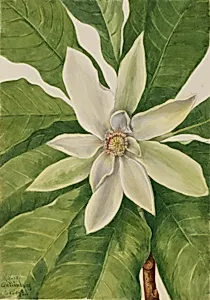
Umbrella Tree (Magnolia tripetala)
Medium
Painting
Classification
Painting
Department
Smithsonian Collection
Museum
Smithsonian American Art Museum
Credit
Smithsonian American Art Museum, Gift of the artist
Accession Number
1970.355.57
Rights
Public Domain
Tags
Art Historical Context
Mary Vaux Walcott's *Umbrella Tree (Magnolia tripetala)*, painted in 1932, captures the elegant drooping flowers and distinctive foliage of this native North American tree, also known as the umbrella magnolia. Walcott, a pioneering Quaker artist and amateur botanist (1860–1940), devoted decades to documenting wildflowers with scientific precision. Gifted by the artist to the Smithsonian American Art Museum, this work exemplifies her lifelong passion for blending art and natural history. Rendered in watercolor—a medium she mastered for its luminous transparency and detail—Walcott's painting showcases her meticulous technique. Each petal, leaf vein, and subtle color gradation reflects her fieldwork in the Appalachian Mountains and beyond, where she sketched specimens en plein air. Her style aligns with the late 19th- and early 20th-century naturalist tradition, prioritizing accuracy over embellishment, much like the works of contemporaries such as Maria Sibylla Merian. This piece holds cultural significance as part of Walcott's vast oeuvre of over 900 wildflower illustrations, published in the landmark *North American Wild Flowers* (1925). It not only preserves the fragile beauty of Magnolia tripetala, a deciduous tree celebrated for its prehistoric lineage, but also highlights women's contributions to American botany during an era when such fields were male-dominated. A delightful window into nature's artistry!