
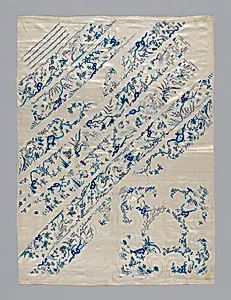
Uncut Yardage (For Woman's Coat)
Qing dynasty (1644–1911), 1875/1900
Medium
Panel of uncut sleeve bands and collar edging, shades of blue embroidery on cream satin.
Dimensions
98.8 × 72.1 cm (38 7/8 × 28 3/8 in.)
Classification
textile
Department
Textiles
Museum
Art Institute of Chicago
Accession Number
52212
Rights
Public Domain
Art Historical Context
Welcome to the Textiles gallery, where we encounter *Uncut Yardage ( Woman's Coat)*, a exquisite panel from China's Qing dynasty (1644–1), dated around 1875–1900. Crafted by Han artisans—the ethnic majority under Manchu rule—this piece represents the opulent world of late imperial fashion. Measuring nearly 99 by 72 cm, it consists of uncut sleeve bands and collar, preserved in its raw yardage form before tailoring into a woman's coat. This format highlights the meticulous planning in garment design, where fabric was first embroidered and then precisely cut. The artwork shines through its masterful embroidery in varied shades of blue on luxurious cream satin. Satin's smooth, lustrous weave provided an ideal canvas for the fine stitching, creating depth and vibrancy that would have caught the light beautifully on a finished garment. Qing-era textiles like this exemplify the era's technical prowess, blending functionality with artistry in women's attire, often reserved for elite classes. Culturally, such pieces underscore the Qing dynasty's fusion of tradition and refinement, where embroidery motifs (though subtle here in blue tones) symbolized status and harmony. Displayed at the Art Institute of Chicago, it invites us to appreciate the unseen labor behind imperial elegance—a testament to Han Chinese textile heritage.
About the Artist
Han-Chinese
**Han-Chinese** was the collective attribution given to anonymous artisans of Han Chinese descent who crafted intricate embroidered textiles during the Qing dynasty (1644–1911). These makers, active primarily in the late 18th to early 20th centuries, specialized in luxurious garments and furnishings that showcased the pinnacle of Han Chinese needlework traditions. Their early lives and individual ...