
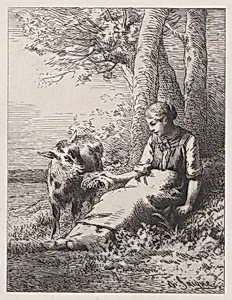
Une Amitié
1867
Medium
Etching and drypoint
Dimensions
Plate: 7 1/16 × 4 3/4 in. (18 × 12 cm) Image: 4 9/16 × 3 9/16 in. (11.6 × 9 cm)
Classification
Prints
Department
Drawings and Prints
Museum
Metropolitan Museum of Art, New York, NY
Credit
Harris Brisbane Dick Fund, 1927
Accession Number
27.10.70
Rights
Public Domain
Art Historical Context
"Une Amitié"A Friendship), created by Jacque in 7, captures a tender moment between animals in a rural setting, a theme central to the artist’s work. A leading figure of the Barbizon School, Jacque specialized in realistic depictions of farm life, particularly sheep and poultry, moving away from idealized academic subjects toward direct observation of nature. This intimate etching and drypoint reflects the 19th-century interest in honest portrayals of the countryside during France rapid industrialization. Jacque was renowned as a master printmaker who helped revive etching as a serious artistic medium. Combining etching’s precise lines with drypoint’s soft, velvety burr, he achieved rich tonal contrasts and delicate textures that bring warmth and liveliness to the scene. The small plate size enhances the work’s personal, almost sketch-like quality, inviting close viewing. Acquired by the Metropolitan Museum of Art through the Harris Brisbane Dick Fund in 1927, this print exemplifies the Barbizon artists’ lasting influence on modern printmaking and their celebration of quiet, everyday connections in the natural world.
About the Artist
Charles Jacque · 1813–1894
Charles-Émile Jacque (1813–1894) was a pioneering French painter, engraver, and illustrator whose career bridged the worlds of printmaking and pastoral painting. Born in Paris amid a difficult childhood, he apprenticed at age seventeen to a map engraver, mastering drypoint technique and producing his first etching in 1830—a copy of a head after Rembrandt. After serving seven years in the French Ar...