
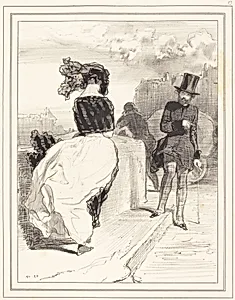
"Une de ces mines pudibones"
probably c. 1843
Medium
lithograph on wove paper
Dimensions
image: 22.2 x 15 cm (8 3/4 x 5 7/8 in.) sheet: 33.7 x 25.3 cm (13 1/4 x 9 15/16 in.)
Classification
Department
CG-E
Museum
National Gallery of Art, Washington, D.C.
Credit
Gift of Dr. Ruth B. Benedict
Accession Number
1983.104.1
Rights
Public Domain
Art Historical Context
**"Une de ces mines pudones" by Paul Gav (c. 1843)** Step into the sharp-witted world of Parisian satire with Paul Gavarni's lithograph *Une de ces mines pudones* ("One of those prudish"), created around 1843. Gavarni, a master illustrator of 19th-century France, captured the bustling social scenes of the July Monarchy era through his keen eye for human folly. This print, measuring 22.2 x 15 cm, exemplifies his signature style: humorous vignettes poking fun at bourgeois pretensions, fashion, and hypocrisy, often published in popular journals like *Le Charivari*. Lithography on wove paper was Gavarni's preferred medium, allowing fluid lines and tonal subtleties that mimicked drawing while enabling mass reproduction—a revolutionary technique for disseminating caricature during France's vibrant print culture. Here, the title slyly critiques "pudibond" sanctimony, likely mocking the exaggerated modesty of high society women amid the era's shifting morals and growing women's visibility in public life. Housed in the National Gallery of Art's Prints department (gift of Dr. Ruth B. Benedict), this work highlights Gavarni's enduring influence on visual satire, bridging Romanticism and Realism while inviting us to chuckle at timeless pretensions. (198 words)
About the Artist
Paul Gavarni · 1804–1866
Paul Gavarni, born Sulpice Guillaume Chevalier on January 13, 1804, in Paris to a cooper father from Burgundy and mother Marie-Monique Thiémet—whose brother, painter Guillaume Thiémet, served as his godfather—began his career far from the art world. As a youth, he worked in a machine factory and studied mechanical drawing at the Conservatoire des Arts et Métiers in 1818, followed by evening classe...