
Unemployment (Erwerbslos)
1925
Medium
woodcut
Classification
Department
CG-W
Museum
National Gallery of Art, Washington, D.C.
Credit
Rosenwald Collection
Accession Number
1943.3.5227
Rights
Public Domain
Art Historical Context
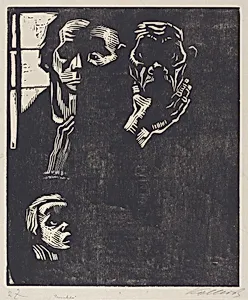
Käthe Kollwitz'sUnemployment (Erwerlos)*, a stark 1925 woodcut from the Gallery of Art's Rosenwald Collection (CG-W, Prints department), captures the human toll of economic despair in Weimar Germany. Created amid hyperinflation and mass joblessness following World War I, the print reflects Kollwitz's lifelong commitment depicting the struggles of the working class. As a pioneering female artist in a male-dominated field, she drew from personal observations of Berlin's impoverished neighborhoods, using her art as a cry for social justice. The woodcut medium amplifies the image's raw power: carved into wood blocks and printed with bold contrasts of black and white, it evokes the rough-hewn textures of hardship itself. Kollwitz, associated with German Expressionism, favored this technique for its directness and accessibility, allowing wide dissemination of her message through affordable prints. Her figures—huddled, weary, and resilient—convey profound empathy, blending realism with emotional intensity. This poignant work not only showcases Kollwitz's mastery of printmaking but also stands as a timeless testament to resilience amid adversity, inviting viewers to reflect on labor's dignity in any era.
About the Artist
Käthe Kollwitz · 1867–1945
Käthe Kollwitz (1867–1945) was a German artist whose powerful images of poverty, war, and maternal grief established her as the foremost practitioner of socially engaged art in early 20th-century Europe. Working primarily in printmaking—including etching, lithography, and woodcut—as well as drawing and sculpture, Kollwitz created works of raw emotional power that gave voice to the suffering of wor...