
Man and Woman
1905
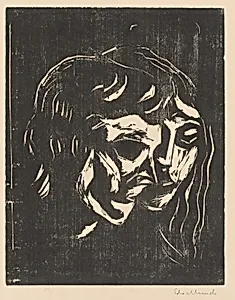
Medium
woodcut in black on wove paper
Dimensions
plate: 25.08 × 19.84 cm (9 7/8 × 7 13/16 in.) sheet: 30.48 × 29.21 cm (12 × 11 1/2 in.)
Classification
Department
CG-E
Museum
National Gallery of Art, Washington, D.C.
Credit
Gift of the Epstein Family Collection
Accession Number
2018.204.1
Rights
Public Domain
Art Historical Context
Edvard Munch's *Man and Woman* (1905) is a striking woodcut print that captures the artist's lifelong fascination with human relationships, love, and emotional tension. As a pioneer of Expressionism, Munch channeled personal anguish and psychological depth into his works, often drawing from his own turbulent experiences. This intimate depiction of a couple, rendered in bold black lines on wove paper, exemplifies his shift toward printmaking as a democratic medium to reach wider audiences beyond oil paintings. The woodcut—carving images into wood blocks and printing them in relief—allowed Munch to achieve dramatic contrasts and raw, jagged contours that convey inner turmoil. Measuring just 25.08 × 19.84 cm on the plate, the composition's simplicity amplifies its emotional power, with stark forms evoking isolation even in closeness. Munch produced multiple states of this print, experimenting with textures and tones unique to woodcut, distinguishing it from his more fluid lithographs. Housed in the National Gallery of Art's Prints department as a gift from the Epstein Family Collection, *Man and Woman* reflects Munch's innovative print oeuvre from the early 20th century. It invites visitors to ponder the universal push-pull of intimacy, bridging Norwegian Symbolism with modern Expressionism.
About the Artist
Edvard Munch · 1863–1944
Edvard Munch (1863-1944) was a Norwegian painter and printmaker whose intensely psychological works made him a pioneer of Expressionism and one of the most influential artists of the modern era. His 1893 masterpiece 'The Scream' has become an iconic symbol of existential anxiety. Munch's art was profoundly shaped by personal tragedy—his mother died when he was five, his beloved sister Sophie at fo...