
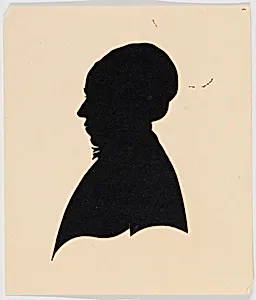
Unidentified profile portrait, woman facing left
1773–1820
Medium
Cut black paper silhouette
Dimensions
3 3/4 × 3 1/4 in. (9.5 × 8.2 cm)
Classification
Cut Paper
Department
Drawings and Prints
Museum
Metropolitan Museum of Art, New York, NY
Credit
Gift of Leopold Heinemann, 1948, transferred from the Library
Accession Number
2013.141.6
Rights
Public Domain
Tags
Art Historical Context
This delicate cut-paper silhouette captures the graceful profile of an unidentified woman left, crafted by an anonymous German artist 1773 and 1820. Measuring just 3¾ × 3¼ inches, the work exemplifies the Schattenriss technique—intricately scissor-cut from black paper and likely mounted against a contrasting background to highlight its stark, elegant lines. Such miniatures demanded remarkable precision, distilling a sitter's likeness to essential contours without color or detail. In late 18th- and early 19th-century Europe, silhouettes like this one democratized portraiture, offering an affordable alternative to oil paintings or enamels for the rising middle class. Popularized after the 1770s, they flourished until photography eclipsed them around 1840, serving as sentimental keepsakes, mourning pieces, or decorative items. German artisans excelled in this folk art form, blending craft with portrait tradition. Today, housed in the Metropolitan Museum of Art's Drawings and Prints department (gift of Leopold Heinemann, 1948), this anonymous gem invites us to ponder the woman's story—perhaps a beloved wife, mother, or local notable—frozen in shadow yet vividly alive through silhouette's timeless allure.