
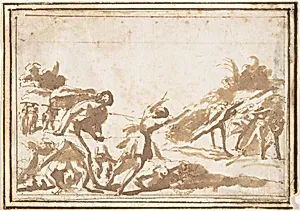
Unidentified Scene: Figures in a Landscape
1624–63
Medium
Pen and brown ink; framing lines in pen and brown ink
Dimensions
3-1/8 x 4-1/2 in. (7.9 x 11.4 cm)
Classification
Drawings
Department
Drawings and Prints
Museum
Metropolitan Museum of Art, New York, NY
Credit
Gift of Cornelius Vanderbilt, 1880
Accession Number
80.3.23
Rights
Public Domain
Tags
Art Historical Context
Nestled among the Metropolitan Museum of Art's treasures in the Drawings and Prints department, *Unidentified Scene: Figures in a Landscape* by Francesco Allegrini (c. 1613–1663) captures the charm of 17th-century Italian draughtsmanship. Created sometime between 1624 and 1663, this intimate pen and brown ink drawing measures just 3-1/8 x 4-1/2 inches, framed delicately with the same medium. Allegrini, a Gubbio-born artist active in Rome, specialized in lively landscapes populated by diminutive figures, blending pastoral serenity with subtle narrative intrigue. Rendered in precise brown ink lines, the work exemplifies the preparatory sketches valued in the Baroque era, where drawings served as studies for paintings or standalone gems. The small scale invites close inspection, revealing Allegrini's skill in suggesting depth through hatching and economical strokes—hallmarks of Roman and Bolognese influences. Human figures animate the expansive landscape, evoking everyday rural life or mythological reverie, a common motif in period art. A generous gift from Cornelius Vanderbilt in 1880, this piece highlights the Gilded Age passion for Old Master drawings, preserving Allegrini's legacy for modern eyes. Though the scene remains unnamed, it whispers of Italy's golden age of landscape depiction, bridging observation and imagination.
About the Artist
Francesco Allegrini · 1615–1679
Francesco Allegrini (c. 1615/20–after 1679), born likely in Rome to the painter Flaminio Allegrini from Cantiano near Gubbio, emerged from a family of artists that included his sister, Anna Angelica Allegrini. He trained under Giuseppe Cesari, known as the Cavalier d’Arpino, around 1638–40, before entering the studio of Pietro da Cortona, whose dynamic Baroque style profoundly shaped his own. Elec...