
Untitled
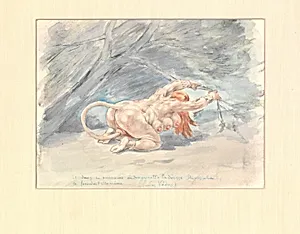
Medium
Watercolor and colored pencil on paper
Dimensions
9 × 11 9/16 in. (22.9 × 29.4 cm)
Classification
Drawings
Department
Modern and Contemporary Art
Museum
Metropolitan Museum of Art, New York, NY
Credit
The Muriel Kallis Steinberg Newman Collection, Gift of Muriel Kallis Newman, 2006
Accession Number
2006.32.54
Rights
Public Domain
Tags
Art Historical Context
Félicien Rops, a pioneering Belgian artist of the late 19th century, this untitled watercolor and colored pencil on paper, blending delicate media to evoke ethereal yet provocative visions. Known for his affiliation with Symbolism and the Decad movement, Rops often explored themes of fantasy, eroticism, and the mac, drawing inspiration from literature like Baudelaire's works. Though the exact date remains unknown, this piece exemplifies his mastery in capturing mythical creatures—those enigmatic beings that bridge the human world and the supernatural. The intimate scale (9 × 11 9/16 in.) suits Rops' intimate, illustrative style, where watercolor's fluidity merges with colored pencil's precision for luminous, textured effects. Such techniques allowed him to infuse otherworldly figures with a haunting sensuality, challenging Victorian-era norms and anticipating modernist explorations of the psyche. Housed in the Metropolitan Museum of Art's Modern and Contemporary Art Department as part of The Muriel Kallis Steinberg Newman Collection (gifted in 2006), it reflects Rops' enduring influence on artists who dared to visualize the forbidden. Visitors will appreciate how Rops transforms paper into a portal for mythical reverie, reminding us of art's power to conjure the imagination's darkest delights.
About the Artist
Félicien Rops · 1833–1898
Félicien Rops, born Félicien Victor Joseph Rops on July 7, 1833, in Namur, Belgium, to a prosperous textile manufacturing family, displayed prodigious artistic talent from youth. The only child of Nicholas Rops and Sophie Maubile, he received private tutoring until age ten, followed by education at a Jesuit school in Namur (1843–1848), the Athénée Royal de Namur, and the Academy of Fine Arts there...