
Untitled
1857
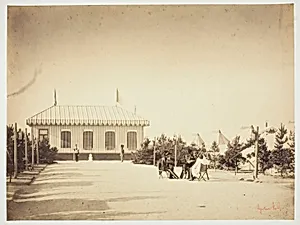
Medium
Albumen print, from the album "Souvenirs du Camp de Châlons"
Dimensions
Image/paper: 27.1 × 36.2 cm (10 11/16 × 14 5/16 in.); Album page: 52.8 × 63.7 cm (20 13/16 × 25 1/8 in.)
Classification
albumen silver print
Department
Photography and Media
Museum
Art Institute of Chicago
Accession Number
144424
Rights
Public Domain
Art Historical Context
Gustave Le Gray, a pioneering French photographer of the 1850s, captured this untitled albumen silver print in 1857 as part of his album *Souvenirs Camp de Châlons Le Gray was a master of early photographic techniques, renowned for his landscapes and innovative use of light, which bridged Romanticism and the emerging realist impulses of mid-19th-century France. This image, measuring 27.1 × 36.2 cm on its album page, exemplifies the exquisite detail and warm tonality of the albumen process—where paper coated in egg whites and silver salts produced richly nuanced prints prized for their clarity and depth. The *Souvenirs du Camp de Châlons* album documents life at the vast military training camp near Châlons-en-Champagne, a key site Napoleon III's Second Empire. Established in 1857, the camp symbolized France's modernization amid rising European tensions. Le Gray's photographs, likely commissioned or collected as souvenirs, offer rare glimpses into camp routines, blending documentary precision with artistic composition—a hallmark of photography's transition from novelty to serious art form. H in the Art Institute of Chicago's Photography and Media department, this print highlights Le Gray's technical prowess, including his experiments with exposure and printing influenced generations. For visitors, it invites reflection on how 19th-century images immortalized fleeting military spectacles, preserving history in silver and light.
About the Artist
Gustave Le Gray · 1820–1884
Gustave Le Gray, born on August 30, 1820, in Villiers-le-Bel near Paris to a prosperous merchant family, pursued his artistic ambitions against his parents' wishes for a legal career. As an only child, he trained as a painter in the studios of François-Édouard Picot and Paul Delaroche at the École des Beaux-Arts, exhibiting at the Paris Salons in 1848 and 1853. In 1844, he married Palmira Leonardi...