
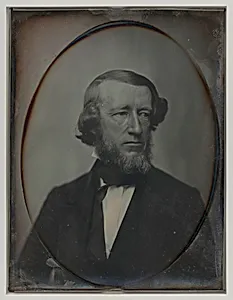
Untitled (Erastus Hopkins, Free Soiler)
Medium
Daguerreotype
Dimensions
21.3 × 16.3 cm (8 7/16 × 6 7/16 in.); Frame: 30.5 × 25.3 × 0.8 cm (12 1/16 × 10 × 3/8 in.); Plate: 21.6 × 16.6 cm (8 1/2 × 6 1/2 in.)
Classification
portrait
Department
Photography and Media
Museum
Art Institute of Chicago
Accession Number
249876
Rights
Public Domain
Art Historical Context
This striking daguerreotype portrait, created in 1852 by the Boston firm Southworth & Hawes, captures Erastus Hopkins, a prominent advocate for the Free Soil movement. The image exemplifies the studio’s renowned approach to early photography, emphasizing clarity, dignified pose, and subtle tonal gradations that bring the sitter’s presence vividly to life. As one of the first practical photographic processes, the daguerreotype offered unprecedented detail and immediacy, transforming how individuals could be documented and remembered. The medium’s significance lies in its technical demands and cultural impact. Each plate required careful preparation and long exposure times, resulting in unique, mirror-like images prized for their sharpness and permanence. Southworth & Hawes elevated the daguerreotype from mere record to artistic statement, producing portraits that conveyed both personal character and social standing during a period of rapid technological and political change. Hopkins’s identification as a “Free Soiler” situates the work within the heated debates over slavery’s expansion in the 1850s. The portrait thus serves as both a personal likeness and a quiet testament to the era’s growing abolitionist sentiments, preserved through an innovative artistic medium that helped shape American visual culture.