
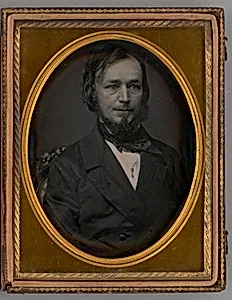
Untitled (Portrait of Man)
Medium
Daguerreotype
Dimensions
10.8 × 8.2 cm (4 5/16 × 3 1/4 in.); Open case: 11.9 × 18.6 × 1.2 cm (4 11/16 × 7 3/8 × 1/2 in.); Case: 11.9 × 9.3 × 1.7 cm (4 11/16 × 3 11/16 × 11/16 in.); Plate: 10.8 × 8.3 cm (4 1/4 × 3 1/4 in.)
Classification
portrait
Department
Photography and Media
Museum
Art Institute of Chicago
Accession Number
249867
Rights
Public Domain
Art Historical Context
Step into the dawn of photography with *Untitled (Portrait of Man, a exquisite daguerreotype by John Adams Whipple from 1854. Housed in the Art Institute of Chicago's and Media department, this intimate portrait captures a gentleman in a small, jewel-like plate measuring just 10.8 × 8.2 cm, typical of the era's protective cases that safeguarded these fragile treasures. Whipple, a pioneering Boston photographer, mastered the daguerreotype process—photography's first practical method, introduced in 1839. Unlike later prints, each daguerreotype is a unique, mirror-reversed image on a silvered copper plate, polished to a mirror finish and exposed in a camera obscura. By 1854, Whipple was renowned for his technical precision and luminous portraits, often posing subjects with dramatic lighting to reveal character and texture. This work exemplifies the medium's golden age, just before cheaper alternatives eclipsed it. Held in its ornate case, the portrait invites us to ponder mid-19th-century identity and innovation. Whipple's skill turned fleeting moments into enduring legacies, bridging art and science in an age of wonder. A testament to early photographic artistry!