
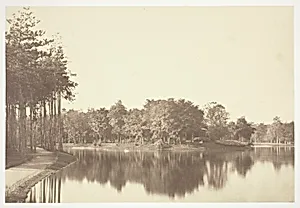
Untitled, from the series "Bois de Boulogne"
c. 1850
Medium
Albumen print
Dimensions
Image/paper: 23.8 × 35 cm (9 3/8 × 13 13/16 in.); Mount: 41.1 × 58.2 cm (16 3/16 × 22 15/16 in.)
Classification
albumen silver print
Department
Photography and Media
Museum
Art Institute of Chicago
Accession Number
68043
Rights
Public Domain
Art Historical Context
Charles Marville's *Untitled, from the seriesBois de Boulogne"* (c. 1850) captures the serene allure of Paris's Bois de Boulogne, a sprawling park on the city's western edge that served as a haven for leisurely strolls and equestrian outings during the mid-19th century. the official photographer for Baron Haussmann's sweeping urban renovations under Napoleon III, Marville Paris's evolving landscape with meticulous precision. This untitled image, likely featuring the park's lush paths or wooded vistas, reflects the Romantic fascination with nature amid rapid modernization, preserving a moment before the city's transformation. Printed as an albumen silver print—a pioneering 19th-century process using egg whites to create a smooth, glossy surface for sharp details and rich tonal range—this work exemplifies early photography's technical triumphs. Measuring 23.8 × 35 cm on its original mount, it showcases Marville's mastery of large-format views, where long exposures demanded steady tripods and calm subjects, rendering foliage and light with exquisite clarity. Housed in the Art Institute of Chicago's Photography and Media department, this piece highlights photography's role in bridging art and documentation. It invites visitors to ponder how Marville's lens not only recorded beauty but foreshadowed Paris's modern identity, blending poetic realism with historical foresight.
About the Artist
Charles Marville · 1813–1879
**Charles Marville**, born Charles François Bossu on July 17, 1813, in Paris, adopted his professional pseudonym around 1832 to avoid the stigma of "bossu," meaning hunchback in French. Trained as a painter, engraver, and illustrator, he spent nearly two decades producing woodblock illustrations for books and magazines before embracing photography around 1850. His transition coincided with the med...