
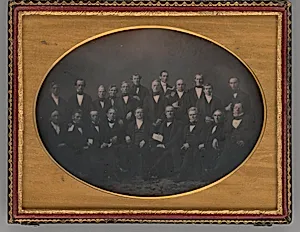
Untitled (Group Portrait of Men)
Medium
Daguerreotype
Dimensions
10.7 × 14 cm (4 1/4 × 5 9/16 in.); Open case: 23.5 × 15 × 1 cm (9 5/16 × 5 15/16 × 7/16 in.); Case: 23.5 × 11.7 × 2 cm (9 5/16 × 4 5/8 × 13/16 in.); Plate: 10.8 × 14 cm (4 1/4 × 5 1/2 in.)
Classification
portrait
Department
Photography and Media
Museum
Art Institute of Chicago
Accession Number
249868
Rights
Public Domain
Art Historical Context
John Adams Whipple’s *Untitled (Group Portrait of Men)*, created in 1852, offers a fascinating glimpse into the early days of photography. As a leading American practitioner of the daguerreotype process, Whipple helped popularize this revolutionary medium in the United States The image, housed in an ornate protective case typical of the era, captures a gathering of unidentified gentlemen with remarkable clarity and detail, reflecting the formal conventions of mid-nineteenth-century portraiture. Daguerreotypes, introduced in 1839, produced unique, highly detailed positives on silver-plated copper sheets. This technique required long exposure times, making group sittings especially challenging as sitters had to remain perfectly still. Whipple’s work demonstrates the medium’s artistic potential, transforming what was often seen as a scientific novelty into a respected form of visual documentation. Now part of the Art Institute of Chicago’s Photography and Media collection, this portrait illustrates photography’s growing role in preserving social history. Its modest scale and elegant case remind viewers how early photographs were cherished personal objects, bridging painting traditions with the modern image-making that would soon transform visual culture.