
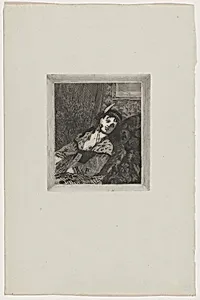
Untitled (La femme à la toque écossaise)
1895
Medium
etching and aquatint in black on green japan paper
Classification
Department
CG-E
Museum
National Gallery of Art, Washington, D.C.
Credit
Virginia and Ira Jackson Collection, gift in memory of Virginia H. Jackson
Accession Number
1996.151.218
Rights
Public Domain
Art Historical Context
Félicien Rops, a Belgian Symbolist artist renowned for his provocative and decadent imagery, created *Untitled (La femme à toque écossaise)* 1895, near the end of his prolific career. This print captures the fin-de-siècle fascination with sensuality and exoticism, likely portraying a woman adorned in a Scottish toque—a fur-trimmed hat evoking both elegance and allure. Rops a master printmaker influenced by the erotic poetry of Charles Baudelaire, often blended beauty with the macabre, reflecting the cultural tensions of late 19th-century Europe amid industrialization and moral upheaval. The work employs etching and aquatint techniques in black ink on luxurious green Japan paper, a specialty import prized for its velvety texture and subtle sheen that enhances tonal depth. Etching provides crisp, incisive lines, while aquatint adds rich, painterly gradations akin to watercolor washes, allowing Rops to achieve dramatic contrasts and atmospheric effects. This combination exemplifies the technical virtuosity of 19th-century printmaking, bridging painting and graphics for intimate, collectible art. Housed in the National Gallery of Art's Virginia and Ira Jackson Collection (gift in memory of Virginia H. Jackson), this piece highlights Rops' enduring legacy in exploring human desire and the grotesque, inviting visitors to ponder the Symbolist gaze on femininity and fantasy.
About the Artist
Félicien Rops · 1833–1898
Félicien Rops, born Félicien Victor Joseph Rops on July 7, 1833, in Namur, Belgium, to a prosperous textile manufacturing family, displayed prodigious artistic talent from youth. The only child of Nicholas Rops and Sophie Maubile, he received private tutoring until age ten, followed by education at a Jesuit school in Namur (1843–1848), the Athénée Royal de Namur, and the Academy of Fine Arts there...