
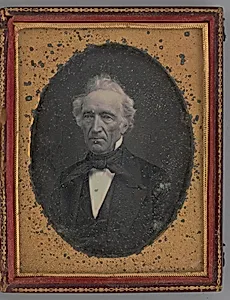
Untitled (Portrait of a Man)
1854
Medium
Daguerreotype
Dimensions
10.8 × 8.2 cm (4 5/16 × 3 1/4 in.); Open case: 12 × 18.6 × 1 cm (4 3/4 × 7 3/8 × 7/16 in.); Case: 12 × 9.3 × 1.9 cm (4 3/4 × 3 11/16 × 3/4 in.); Plate: 10.8 × 8.3 cm (4 1/4 × 3 1/4 in.)
Classification
portrait
Department
Photography and Media
Museum
Art Institute of Chicago
Accession Number
249904
Rights
Public Domain
Art Historical Context
Step into the dawn of photography with *Untitled (Portrait of a)*, a captivating daguerreotype from 4 created by an unknown maker. This intimate portrait, housed in the Art Institute of Chicago's Photography Media department, captures a solemn male subject in exquisite detail on a small silvered copper plate measuring just 10.8 × 8.3 cm. Encased for protection in a compact leather or thermoplastic holder—typical of the era—this diminutive treasure (open case: 12 × 18.6 × 1 cm) invites visitors to peer closely, as if meeting a figure from mid-19th-century life. Daguerreotypes, invented by Louis Daguerre in 1839 and perfected in the 1840s, marked photography's revolutionary debut, producing one-of-a-kind, mirror-like images that couldn't be duplicated. By 1854, this process dominated portraiture, especially in America and Europe, where studios churned out millions for middle-class families. The subject's steady gaze reflects the challenge of long exposure times—often minutes—demanding immaculate stillness amid bright studio lights. No painted backdrop or props distract; the focus is pure, lifelike realism. This anonymous yet poignant work highlights photography's cultural shift from handcrafted art to mechanical precision, democratizing portraiture beyond elite painters. Gaze upon it, and feel the thrill of history's first "photos," bridging our world to a vanished moment.