
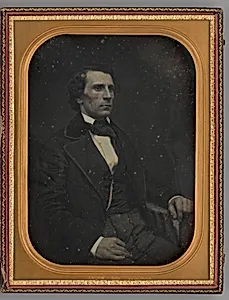
Untitled (Portrait of a Seated Man)
1855
Medium
Daguerreotype
Dimensions
21.7 × 16.5 cm (8 9/16 × 6 1/2 in.); Open case: 23 × 37.6 × 1.1 cm (9 1/16 × 14 13/16 × 7/16 in.); Case: 23 × 18.8 × 2.1 cm (9 1/16 × 7 7/16 × 7/8 in.); Plate: 21.6 × 16.6 cm (8 1/2 × 6 1/2 in.)
Classification
portrait
Department
Photography and Media
Museum
Art Institute of Chicago
Accession Number
249886
Rights
Public Domain
Art Historical Context
In the mid-19th century, at the dawn of photography's golden age, Rufus Anson crafted this *Untitled (Portrait of a Seated Man)* in 1855 using the daguerreotype process—a pioneering technique invented by Louis Daguerre in 1839. Housed in an ornate case measuring about 23 × 18.8 × 2.1 cm, this intimate 21.7 × 16.5 cm silvered copper plate captures a single, unique image that shimmers like a mirror when tilted, demanding the viewer's active gaze. Anson, a skilled New York daguerreotypist, exemplifies the era's portrait specialists who turned everyday sitters into dignified subjects. Daguerreotypes like this one marked a revolutionary shift from painted portraits, offering unprecedented detail and realism at a fraction of the cost. By 1855, the medium was at its peak in America, with studios bustling as families and professionals sought these treasured likenesses—often the only photographs they'd ever own. The seated pose, typical of the time, reflects long exposure times (up to 20-30 seconds), requiring stillness amid studio props for stability. Today, at the Art Institute of Chicago's Photography and Media department, this work invites us to ponder the human face frozen in mercury-amalgamated silver: a testament to innovation, patience, and the quiet artistry of early photographers bridging art and science.