
Untitled (Portrait of a Man)
1850s
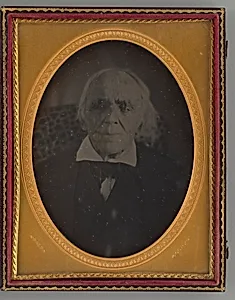
Medium
Daguerreotype
Dimensions
13.9 × 10.8 cm (5 1/2 × 4 5/16 in.); Open case: 15.1 × 24 × 1.4 cm (6 × 9 1/2 × 9/16 in.); Case: 15.1 × 12 × 1.9 cm (6 × 4 3/4 × 3/4 in.); Plate: 14 × 10.8 cm (5 1/2 × 4 1/4 in.)
Classification
portrait
Department
Photography and Media
Museum
Art Institute of Chicago
Accession Number
250064
Rights
Public Domain
Art Historical Context
**Untitled (Portrait of a Man)** by L. H. Hale, ca. 1850s, captures the quiet dignity of its unnamed subject in a pristine daguerreotype—a pioneering photographic process that defined early portraiture. Housed in an ornate case measuring 15.1 × 12 × 1.9 cm, this intimate 13.9 × 10.8 cm image reflects the mid-19th-century fascination with photography as a democratic art form, making lifelike likenesses accessible beyond elite painted portraits. Daguerreotypes, invented in 1839, produced one-of-a-kind positive images on silver-plated copper, renowned for their mirror-like detail and subtle tonal range. Subjects like this man had to remain perfectly still for minutes-long exposures, often using hidden poses or head braces, lending portraits a formal, almost sculptural quality. Hale, a skilled practitioner of this exacting technique, exemplifies how American photographers in the 1850s turned studios into portrait factories, preserving everyday faces amid rapid social change. Held in the Art Institute of Chicago's Photography and Media Department, this work highlights photography's cultural shift from novelty to cherished keepsake, evoking the era's optimism and the human desire for permanence. Visitors, gaze closely—the shimmering plate reveals a world frozen in silver light.