
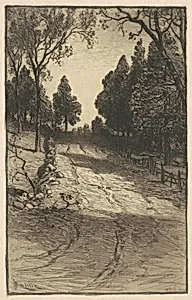
Up the Hill
Medium
etching in black on laid paper
Dimensions
image: 20.32 × 12.7 cm (8 × 5 in.) plate: 21.75 × 13.18 cm (8 9/16 × 5 3/16 in.) sheet: 27.94 × 19.69 cm (11 × 7 3/4 in.)
Classification
Department
CG-W
Museum
National Gallery of Art, Washington, D.C.
Credit
Corcoran Collection (Gift of Mr. S.R. Koehler, Boston, Massachusetts)
Accession Number
2015.19.2468
Rights
Public Domain
Art Historical Context
"Up the Hill" is a delicate etching created by James David Smillie 1879, capturing the essence of 19th-century American landscape. Smillie, a prominent etcher and painter trained in his family's engraving tradition, produced this intimate work on laid paper—a textured, handmade sheet typical of the era, prized for its ability to hold fine ink lines. Measuring just 8 x 5 inches at its image core, the print invites close viewing, evoking a sense of quiet ascent through rural terrain, perhaps symbolizing perseverance or the beauty of everyday paths. This piece emerges from the American etching revival of the 1870s-1880s, a movement that elevated printmaking to fine art status, inspired by European masters like Rembrandt. Smillie, influenced by the Hudson River School's naturalistic style, mastered etching's intaglio technique: acid biting into a metal plate to create rich, velvety tones and intricate details. Donated by S.R. Koehler—a Boston critic and etching advocate—as part of the Corcoran Collection to the National Gallery of Art, it exemplifies how prints democratized art access. Today, "Up the Hill" reminds us of etching's technical brilliance and cultural role in preserving America's pastoral heritage, offering visitors a window into an artist's meticulous craft.