
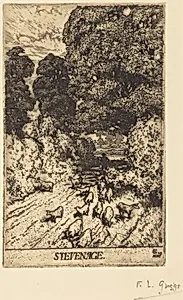
Stevenage
1902
Medium
etching in black
Dimensions
plate: 16.35 × 10.16 cm (6 7/16 × 4 in.)
Classification
Department
CG-W
Museum
National Gallery of Art, Washington, D.C.
Credit
Rosenwald Collection
Accession Number
1943.3.4684
Rights
Public Domain
Art Historical Context
**Stevenage** is a delicate etching created by British artist F.L. Gr in 1902, the essence of the historic Hertfordshire town of Stevenage. just 16.35 × 10.16 cm on the plate, this intimate print exemplifies Griggs' mastery of architectural detail during the early etching revival, a movement that breathed new life into traditional printmaking techniques amid the rise of modern art. Rendered in black ink through the meticulous etching process—where acid etches fine lines into a metal plateGriggs evokes a timeless quality in everyday English scenery. His precise lines and subtle tonal variations highlight textures of stone buildings and rooftops, inviting viewers to linger on the quiet poetry of rural heritage. This work reflects the era's fascination with preserving vanishing vernacular architecture against industrialization. Housed in the National Gallery of Art's Rosenwald Collection, **Stevenage** stands as a testament to Griggs' enduring influence in printmaking, offering museum visitors a window into Edwardian England's nostalgic gaze on its past. (178 words)
About the Artist
F.L. Griggs
Frederick Landseer Maur Griggs (1876–1938), known professionally as F.L. Griggs, was a British etcher and illustrator whose haunting architectural prints rank among the finest achievements in the revival of etching as a fine art medium during the early twentieth century. Born in Hitchin, Hertfordshire, Griggs was largely self-taught as a printmaker, developing his mastery of the etching needle thr...