
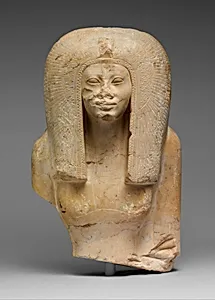
Upper Part of the Seated Statue of a Queen
Unknown Artist
ca. 1580–1550 B.C.
Medium
Indurated limestone, paint
Dimensions
H. 28 cm (11 in.); W. 17.8 cm (7 in.); D. 10 cm (3 15/16 in.)
Classification
Bust, queen, seated, vulture
Period
New Kingdom
Department
Egyptian Art
Museum
Metropolitan Museum of Art, New York, NY
Credit
Rogers Fund, 1916
Accession Number
16.10.224
Rights
Public Domain
Tags
About this artwork
This limestone fragment depicts the upper portion of a seated queen from Egypt's transitional period between the late Seventeenth and early Eighteenth Dynasties, roughly 1580-1550 BC. The sculpture originates from Thebes in Upper Egypt, the political and religious center where New Kingdom pharaohs established their capital and built magnificent temples. The queen's identity remains uncertain, but her representation in indurated limestone with painted details indicates royal status and religious ...
Art Historical Context
This captivating fragment, the *Upper Part of the Seated Statue a Queen*, hails from ancient Thebes in Upper Egypt around 1580–1550 B.C., during the pivotal transition from the late Seventeenth to early Eighteenth Dynasty. Carved in indurated limestone—a durable, hardened stone ideal for enduring temple environments—this 28 cm tall piece captures the upper torso of a royal woman, her identity lost to time but her status unmistakable. Thebes, the era's political and religious heart was where Theban rulers reunified Egypt after expelling the foreign Hyksos invaders, ushering in the prosperous New Kingdom. Artistically, the sculpture embodies timeless Egyptian conventions: rigid frontality, idealized features, and symbolic attributes that conveyed divine authority. Queens of this period wielded significant power, often as regents or influencers in politics and religion. Traces of vibrant paint remain, hinting at an originally lifelike figure with flesh tones, elaborate jewelry, and costumes in brilliant pigments—techniques that brought stone to vivid life for temple rituals and offerings. Acquired by the Metropolitan Museum of Art via the Rogers Fund in 1916, this fragment evokes the dynamism of Egypt's renewal, reminding us of powerful women who shaped one of history's greatest civilizations. Though incomplete, it stands as a testament to artistic mastery and cultural reverence.