
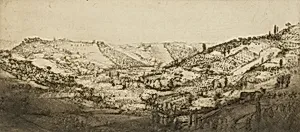
Val d'Ema
Medium
Graphic Arts-Print
Classification
Graphic Arts-Print
Department
Smithsonian Collection
Museum
Smithsonian American Art Museum
Credit
Smithsonian American Art Museum, Gift of Moune G.H. Webster
Accession Number
1974.85.39
Rights
Public Domain
Tags
Art Historical Context
**Val d'Ema** (1909) by Donald MacLaughlan captures the serene beauty of Italy's Val d'Ema, a valley in Tuscany renowned for its olive groves and hills. This graphic arts print, housed in the Smithsonian American Art, invites viewers into a tranquil landscape where ancient olive trees stand as timeless sentinels against a soft, atmospheric backdrop. MacLaughlan, a skilled American etcher active in the early 20 century, often turned his lens to European scenes, blending meticulous detail with evocative mood. Created as a fine print, the work exemplifies the graphic arts medium's power to democratize art—allowing intricate reproductions that could reach wider audiences beyond oil paintings. Etching techniques, likely employed here, enabled MacLaughlan to render the textured bark of olives and subtle gradations of light, evoking the golden hues of Tuscan sunlight. Presented through the generous gift of Moune G.H. Webster, it reflects the era's fascination with Italian pastoral life amid America's growing cultural exchange with Europe. This piece not only showcases MacLaughlan's mastery of printmaking but also preserves the cultural essence of Val d'Ema, a region synonymous with Italy's agrarian heritage. A perfect gem for lovers of landscape art, it whispers of leisurely afternoons under olive boughs. (198 words)
About the Artist
Donald Shaw MacLaughlan · 1876–1938
Donald Shaw MacLaughlan (1876–1938) was born on November 9 in Charlottetown, Prince Edward Island, Canada, though he is recognized as an American artist after his family relocated to Boston, Massachusetts, in 1890. There, as a teenager, he immersed himself in the Boston Public Library's collections of old master prints, studying works by Albrecht Dürer, Rembrandt van Rijn, and eighteenth-century E...